

Preparing for an authority audit often turns into a document-polishing exercise: manuals re-read, records tidied, folders labelled. Some of that helps. But inspectors are rarely asking whether your paperwork is neat. They are asking whether your management system works, and whether the operation on the ramp matches the operation in the manual.
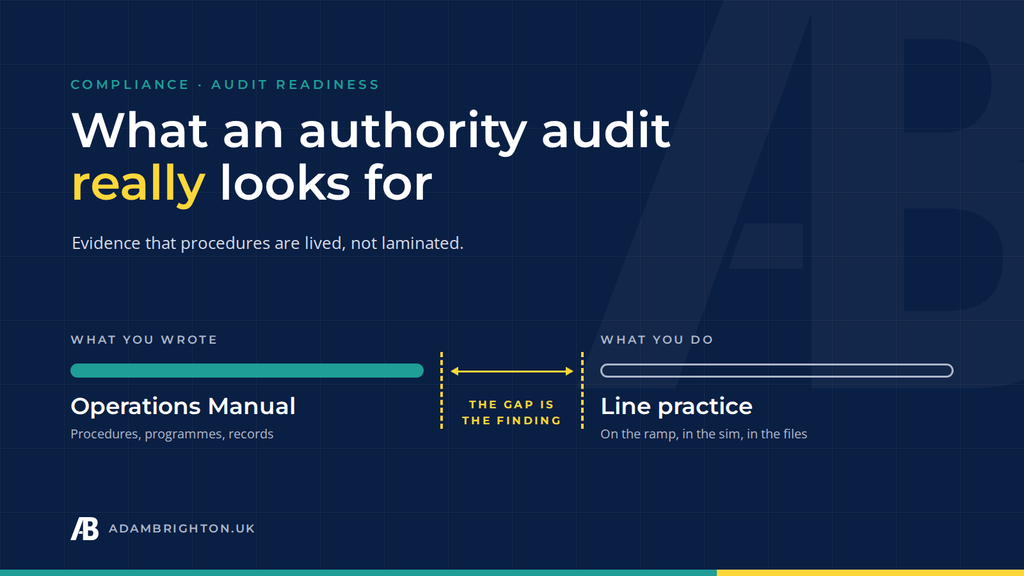
Table of Contents
Evidence that the system finds its own problems
Under EASA rules the operator’s management system, set out in ORO.GEN.200, includes a compliance monitoring function. An inspector wants to see that it is active: an audit programme that is actually delivered, findings that are raised honestly, and corrective actions that close on time.
An internal audit programme with no findings is not reassuring. It suggests the programme is not looking hard enough.
That kind of honesty is not automatic. An authority audit will only see it if crews already trust the system, the same trust that underpins a just culture, where people raise findings against themselves because they believe the system, not the individual, is under review.
Corrective actions that fix causes
Authority findings are classified as level 1 or level 2 under ARO.GEN.350, and the operator must respond with a corrective action plan under ORO.GEN.150. The weakest plans simply restate the finding and promise to do better. The strongest show a root cause analysis, an action that addresses that cause, and a way to check the action worked.
The question behind every audit is simple: if something went wrong tomorrow, would your system notice before we did?
Manuals that match reality
Inspectors will pick a procedure and follow it to the aircraft, the simulator or the training record. If crews do something different from what the manual says, it does not matter which version is safer. The gap is the finding.
Keep the Operations Manual suite current, make amendments easy to understand, and check regularly that line practice and written procedure still agree.
Training records that tell a story
Training and checking records are among the most sampled items in any audit. They need to be complete, but they also need to make sense: qualifications in date, checks conducted by appropriately authorised examiners, and remedial training followed through to a documented outcome.
Five checks before your next authority audit
- Pick three procedures at random and walk each one from manual to practice.
- Review the last year of internal findings: are any overdue, repeated or closed without evidence?
- Sample ten crew training files end to end.
- Check that nominated persons can explain how they oversee their area, in their own words.
- Read your latest safety reports and confirm each one has a documented response.
What happens after the authority audit
A finding that closes on paper but changes nothing has not really closed. The corrective action agreed with the authority should feed back into the compliance monitoring programme: an owner, a deadline, and evidence that the fix actually worked, not just evidence that a task was marked done.
That evidence should reach the people who need it. Line managers should know which findings touched their area and what changed as a result. Training staff should see how a root cause reshaped the syllabus, rather than just receiving an instruction to run a make-up session. Repeat findings are the clearest signal that this loop is not closing: the same gap between manual and practice keeps reappearing because nobody traced it back far enough the first time.
An authority audit that only produces a closed finding has done the minimum. One that changes how the operation actually runs afterwards has done its job, and that is usually visible long before the next inspector arrives.
None of this is about performing for the authority. An operation that can pass these checks on an ordinary Tuesday is simply a well-run operation, and that is what the audit is there to confirm.