

Every airline says it has a just culture. It is in the safety policy, and it is on a poster in the crew room. Yet the real test is not written anywhere. It happens the first time a first officer reports something that makes the operation, or the captain, or the manager reading it, look bad.
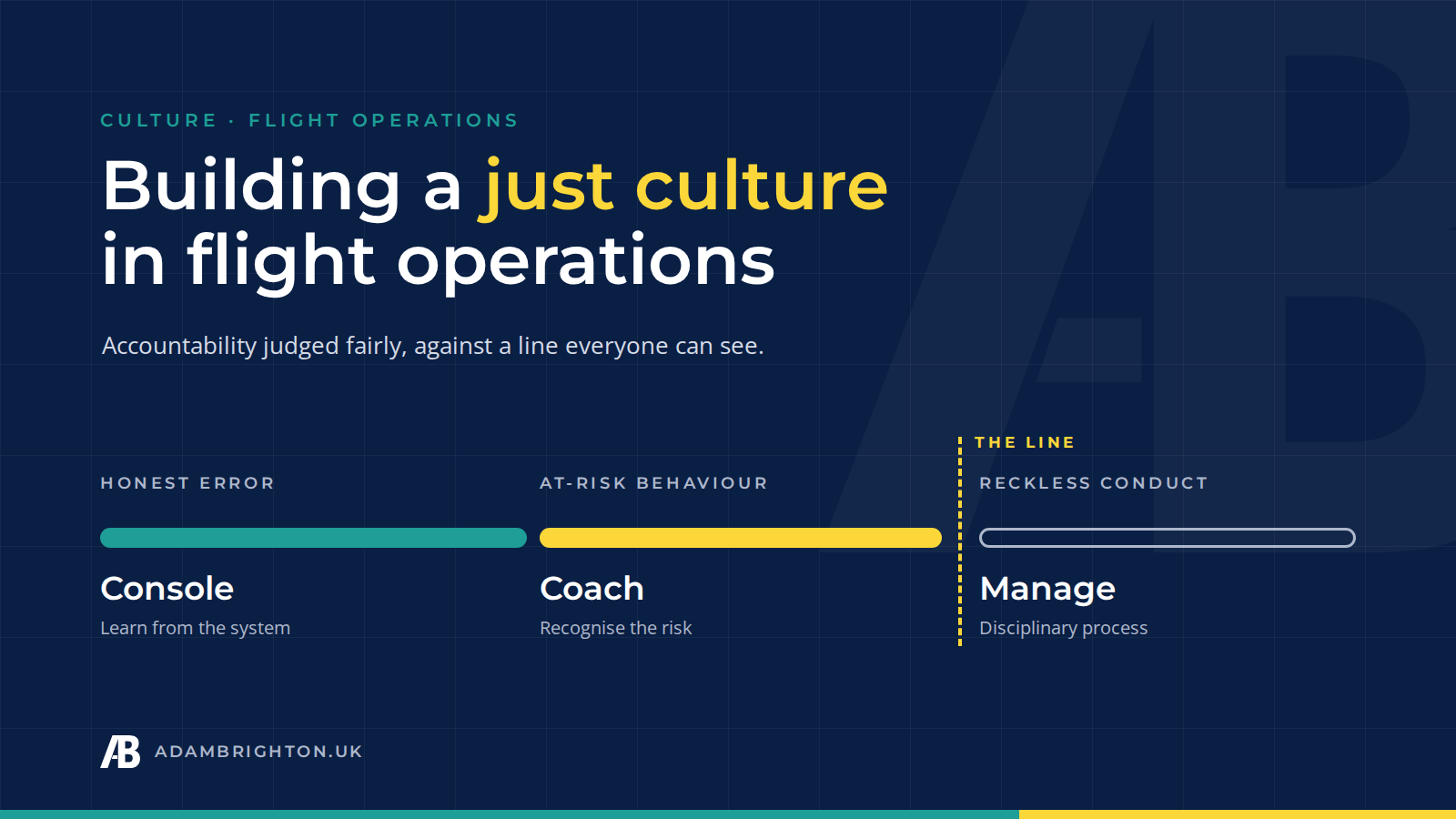
Table of Contents
What a just culture is, and what it is not
A just culture is not a no-blame culture. People are still accountable. The difference is that accountability is judged fairly, against clear lines, and honest mistakes are treated as information about the system rather than as evidence against the individual.
In Europe this is not optional. Regulation (EU) No 376/2014 on occurrence reporting protects the people who report and limits how that information can be used against them. The regulation sets the floor. The culture is what an organisation builds on top of it.
The first report sets the tone
When a report lands on a manager’s desk, three questions matter more than any other:
- Did we thank the reporter? Quickly, personally and before any investigation starts.
- Did we look at the system first? Procedures, rostering, training, equipment and pressure, before the person.
- Did we tell people what changed? A report that disappears into a database teaches people not to bother.
Compliance tells you what good looks like. Culture decides whether it happens at three in the morning on a wet night in winter.
Make the line visible
Crews will only trust a just culture if they know where the line sits. Most organisations use a simple distinction between honest error, at-risk behaviour and reckless conduct. Honest error is consoled and learned from. At-risk behaviour, where the risk was not recognised or was believed to be justified, is coached. Reckless conduct, a conscious disregard of a substantial risk, is managed through the disciplinary process.
Write that line down, train it, and apply it the same way every time. Consistency is what turns a policy into trust.
Where leaders get it wrong
Most failures of a just culture are not dramatic. They are small signals that crews notice long before management does. A report answered with a request for a written statement. An investigation that names a person in the first paragraph and the system in the last. A debrief that opens with “why did you” rather than “what happened”. A quiet word in the corridor that nobody meant as a threat.
None of these break the policy. All of them break trust. Leaders set the tone through the questions they ask in the first ten minutes, not the words they sign in the safety policy.
Close the loop
The most powerful thing a safety department can publish is not a statistic. It is a short note that says: you told us this, here is what we found, and here is what we changed. It shows the reporting system works, and it shows the organisation is listening.
A practical place to start: read the last ten reports your department received and ask how each reporter was treated in the first 48 hours. That answer will tell you more than any audit finding.
What the regulator sees
Inspectors do not audit posters. They look at the reporting rate, the quality of investigations, whether corrective actions address causes rather than symptoms, and whether the same issues keep coming back. A healthy just culture shows up in all of those, and it is very hard to fake.
That is why culture is the safety system. The manuals describe the operation you intend to run. The culture decides the operation you actually run.
More on safety leadership and flight operations in Insights.